
Choosing the best detergent powder for indian households is not simply about buying the most popular brand or the most expensive packet. The right detergent should effectively clean your clothes while matching your fabric type, washing method, water conditions, stain levels, and budget.
With so many laundry detergent powders on the market, it’s critical to consider factors more than packaging and scent. A number of variables can have a significant impact, including cleaning effectiveness, chemicals, fabric compatibility, water hardness, dose, and cost per wash.
Whether you regularly wash everyday cotton clothes, coloured garments, heavily soiled workwear, or delicate fabrics, understanding what to look for can help you make a smarter choice.
If you’re wondering how to choose the best detergent powder, this guide will help you understand what actually matters before making a purchase.
What Makes a Detergent Powder Effective?
An effective detergent needs to do more than create foam. It should loosen dirt and oils from fabrics, keep the removed soil suspended in the wash water, and allow the dirt to rinse away without excessive residue.
Different stains require different cleaning mechanisms. Sweat, body oils, food, mud, grease, tea, and protein-based stains do not behave in exactly the same way.
A well-formulated detergent typically combines several ingredients to address these different types of soil.
The Three Basic Stages of Cleaning
- Soil removal:
Surfactants help loosen dirt, oils, and other soils from the fabric. - Soil suspension:
Other ingredients help keep loosened dirt dispersed in the wash water so it does not easily settle back onto clothes. - Rinsing:
The detergent should rinse away effectively without leaving excessive deposits on the fabric.
This is why more foam does not necessarily mean better cleaning. Foam is only one visible characteristic of a detergent; overall cleaning depends on the formulation and washing conditions.
Why Detergent Formulation Matters
A detergent’s formulation is essentially its cleaning recipe. Two powders may look similar on the shelf but perform differently because they contain different ingredients, concentrations, and combinations.
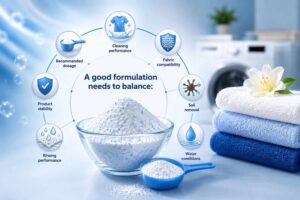
A good formulation needs to balance:
- Cleaning performance
- Fabric compatibility
- Soil removal
- Water conditions
- Rinsing performance
- Product stability
- Recommended dosage
The formulation can also influence whether a product is better suited to hand washing, top-load machines, front-load machines, or specific fabric types.
Therefore, don’t judge detergent only by its fragrance, colour, packaging, or foam. Check its intended use, dosage instructions, and product information.
Key Ingredients in Detergent Powder
Understanding common detergent ingredients can make your buying decision much easier.
-
Surfactants
Surfactants are among the most important cleaning ingredients. They help loosen oils, dirt, and other soils from fabric so they can be carried away with water.
-
Builders
Builders support the cleaning process by helping manage minerals present in water. This can be particularly important in areas with hard water.
-
Enzymes
Some detergents contain enzymes designed to break down specific types of stains. Depending on the formulation, enzymes may target proteins, starches, fats, or other organic residues.
-
Fragrance
Fragrance provides the fresh scent many consumers associate with clean laundry. However, fragrance itself doesn’t determine how effectively a detergent cleans.
-
Anti-redeposition agents
These ingredients help prevent loosened dirt from settling back onto fabrics during washing.
-
Optical brighteners
Some formulations contain optical brightening agents that make fabrics appear brighter or whiter by influencing how light reflects from the fabric surface.
The exact ingredients and concentrations vary between products, so checking the label is always worthwhile.
Important Factors to Consider Before Buying Best Detergent Powder
There isn’t one detergent powder that is perfect for every household. Instead, look for a product that matches your specific laundry routine.
-
Fabric type
Cotton, synthetics, denim, wool, silk, and delicate fabrics have different care requirements. A strong everyday detergent may not be suitable for delicate garments.
-
Washing method
Check whether the detergent is designed for hand washing, top-load machines, front-load machines, or general use.
Using the wrong product can affect cleaning performance and may contribute to excess foam or residue.
-
Water hardness
Hard water contains higher levels of minerals that can interfere with cleaning. If you live in an area with hard water, look for a detergent formulated to perform effectively under those conditions.
-
Stain level
Consider the type of laundry you wash regularly. If your clothes frequently contain:
- Grease
- Food stains
- Mud
- Sweat
- Body oils
- Tea or coffee stains
you may benefit from a detergent designed for stronger soil removal. For particularly stubborn stains, pretreatment may be more effective than simply adding extra detergent.
-
Fragrance
A pleasant scent is appealing, but it shouldn’t be the main criterion for choosing a detergent.
-
Skin sensitivity
If laundry is worn directly against the skin or you have a preference for milder products, pay attention to the product’s stated formulation and washing instructions.
-
Value for money
Don’t compare products only by packet price. Compare the cost per wash or recommended dosage. A larger pack isn’t necessarily cheaper if the product requires a larger amount per load.
Best Detergent Powder for Different Types of Fabrics
The right detergent can depend heavily on the fabric being washed.
| Fabric Type | General Consideration |
| Cotton | Everyday detergent suitable for regular washing |
| Denim | Effective cleaning with appropriate dosage |
| Polyester | Detergent suited for synthetic fabrics |
| Blended fabrics | Follow garment-care instructions |
| Wool | Use a product specifically recommended for wool |
| Silk | Prefer detergent designed for delicate fabrics |
| Baby clothing | Consider mild formulation and thorough rinsing |
| Towels | Focus on effective cleaning and residue removal |
-
Cotton Clothes
Cotton is one of the most commonly washed fabrics in Indian households. A suitable everyday detergent can generally be used according to the manufacturer’s dosage and the garment-care instructions.
-
Polyester and Synthetic Fabrics
Synthetic fabrics such as polyester can retain body oils and odours. Appropriate detergent selection, dosage, and washing practices can help maintain freshness.
-
Denim
Denim is relatively durable but can still benefit from appropriate washing practices. Avoid unnecessarily aggressive washing and follow the garment’s care instructions, particularly for darker colours.
-
Wool and Silk
Wool, silk, lace, and other delicate fabrics may require specialised detergents.
Do not automatically use a strong general-purpose detergent on delicate garments. Always follow the care label and use a fabric-specific product when recommended.
-
Baby Clothes
For baby clothing, consider the garment’s fabric, the detergent’s stated formulation, and the importance of thorough rinsing.
Rather than assuming that a particular detergent is universally suitable for babies, check both the product instructions and clothing-care requirements.
How to Choose Detergent for White and Coloured Clothes
Laundry colour can also influence your detergent choice.
-
White Clothes
For white garments, consider a detergent designed for maintaining fabric cleanliness and brightness. Follow the garment-care instructions and avoid assuming that a stronger detergent is always better.
-
Coloured Clothes
For coloured garments, pay attention to the care label and washing temperature. Proper washing practices can help maintain colour over time.
If a garment has special colour-care instructions, follow those instructions rather than relying solely on the detergent’s marketing claims.
How Much Detergent Should You Use?
The correct detergent quantity depends on several factors:
- Load size
- Soil level
- Water hardness
- Washing method
- Detergent concentration
- Manufacturer instructions
A useful rule is to start with the manufacturer’s recommended dosage.
If the load is lightly soiled, using substantially more detergent may not improve the result. Similarly, heavily soiled laundry may require pretreatment or a suitable wash cycle rather than simply adding extra powder.
A Simple Cost-Per-Wash Calculation
You can compare detergents using this formula:
Cost per wash = Product price ÷ Number of recommended washes
For example, if a ₹500 detergent pack provides approximately 50 recommended washes:
₹500 ÷ 50 = ₹10 per wash
This makes it easier to compare products with different packet sizes.
Follow the manufacturer’s dosage instructions rather than measuring by guesswork.
Common Detergent-Buying Mistakes
Many detergent-buying mistakes happen because consumers focus on one feature instead of the complete product.
- Choosing based only on fragrance: A strong fragrance may make clothes smell pleasant, but it doesn’t necessarily indicate better cleaning.
- Assuming more foam means better cleaning: Foam can be visually satisfying, but cleaning performance depends on the detergent’s formulation, not simply the amount of bubbles produced.
- Ignoring fabric type: Using the same aggressive detergent for every garment may not be the best approach, especially when your wardrobe contains delicate materials.
- Buying solely because it’s cheaper: Price matters, but value matters more. Consider how much detergent is required per wash and how effectively it performs.
- Using too much detergent: This is one of the most common mistakes. More powder can mean more residue rather than cleaner clothes.
- Ignoring washing instructions: Always consider the garment care label and detergent instructions. Temperature, washing method, and dosage can all affect the final result.
How to Compare Detergent Powders
When comparing two or more detergent powders, avoid relying on packaging claims alone.
Create a simple checklist.
| Factor | What to Look For |
| Cleaning performance | Suitable for your typical stains |
| Fabric compatibility | Appropriate for your everyday clothes |
| Washing method | Hand wash or machine compatible |
| Water conditions | Suitable for your local water hardness |
| Dosage | Clear and practical instructions |
| Ingredients | Transparent product information |
| Fragrance | Suitable for your preference |
| Price | Compare cost per wash |
| Packaging | Clear manufacturer and product details |
You can also test a detergent over several washes instead of judging it after one load.
Pay attention to whether clothes look clean, feel comfortable, retain their colour, and rinse properly.
Which Detergent Should You Choose?
Your ideal detergent depends on your specific laundry needs.
- For Everyday Family Laundry: Choose a general-purpose detergent that is suitable for your washing method and the fabrics you wash most frequently.
- For Heavily Soiled Clothes: Look for stronger soil-removal performance and consider pretreatment for stubborn stains.
- For Hard Water: Choose a formulation designed to perform effectively under hard-water conditions.
- For Delicate Fabrics: Use a detergent specifically recommended for wool, silk, or other delicate materials when required.
- For Washing Machines: Select a detergent compatible with your machine type and follow the recommended dosage.
- For Budget-Conscious Buyers: Compare cost per wash, not just the price printed on the packet.
Final Buying Checklist
Before purchasing your next detergent powder, ask yourself these questions:
✓ Does it suit my washing method?
✓ Is it appropriate for the fabrics I wash most often?
✓ Can it handle the type of stains I regularly encounter?
✓ Is the dosage clearly mentioned?
✓ Is the product suitable for my water conditions?
✓ Does the packaging provide adequate product information?
✓ Am I comparing cost per wash rather than packet price alone?
✓ Do I actually need a specialised detergent for certain garments?
If most of the answers are yes, you’ve probably found a product worth trying.
Conclusion
Choosing the Best Detergent Powder for Indian Households doesn’t have to be complicated. The goal isn’t to find the product with the loudest advertising claim, the strongest fragrance, or the most impressive-looking packet.
Instead, focus on what your laundry actually needs.
Consider fabric type, stain level, washing method, water hardness, formulation, dosage, and overall value. Once you understand these factors, comparing detergent powders becomes much easier.
Remember, effective laundry care is about finding the right balance between cleaning performance and fabric care. The best detergent for your home is ultimately the one that consistently cleans your clothes, works well with your washing routine, and provides good value without requiring excessive product.
A little attention before buying can make a noticeable difference to every wash that follows.
For more insights and information on everyday household needs, follow us on
- Facebook: www.facebook.com/hindusthanchemicals
- Instagram: www.instagram.com/hindusthan.chemicals